.

.
Showing posts with label William Castle. Show all posts

Friday, September 10, 2010

Castle Keeper!

13 Ghosts  (Allied Artists, 1960)


Before the Camera:

Charles Herbert (The Fly '58 - he's the kid!)
Jo Morrow (The 3 Worlds of Gulliver)
Martin Milner (TV's Adam 12)
Rosemary DeCamp (Yankee Doodle Dandy)
Donald Woods (The Beast from 20,000 Fathoms)
John Van Dreelen (Sex Kittens Go to College)
and
Margaret Hamilton (The Wicked Witch of the West herself!)


Behind the Camera:

Produced and Directed by William Castle

Written by Robb White


Much has been written about producer/director William Castle - the Movie Gimmicks Master (Even here - see the entry entitled Blog-O-Rama!). From insurance policies against dying of fright to seats wired to tingle the backside, William Castle could sell a movie like no other filmmaker. He opens this movie too, sitting in a cool office set and explaining his new process Illusion-O and how to use the Ghost Viewer you got coming in to the theater. (More on that later)
    For the story, Castle again turned to his frequent writer Robb White, who cobbled up a story of the Zorba family. White must have been getting his kicks where he could find them at this point - get the monikers on this bunch: dad Cyrus (Woods), mom Hilda (DeCamp), daughter Medea (Morrow), and son Buck (top billed Herbert - a very popular child star of the time who obviously had some canny agents and managers). Cyrus is a paleontologist at the local university who apparently makes bupkus at his job; as the film opens he takes a call from Hilda who is letting him know the furniture is being repossessed. Again. (And not by the ghosts. They show up later.) After getting a tush pinch from one of the repo men, (!) Hilda is ready to throw in the towel. Cyrus comes home to his empty house to commiserate, just as a telegram is delivered (luucky!) that lets the Zorbas know they have just inherited a house from Cyrus's eccentric uncle Plato Zorba (and the names keep coming!)
   The family meets Uncle Plato's lawyer Benjamen Rush (Milner) (and yes, it's spelled Benjamen) who passes over the deed, tsk tsk tsking. With a little prompting, Ben advises that Plato had spent his life hunting down and capturing ghosts, which he kept trapped, and that "they come with the house." Eleven of them, to be exact. Ben also passes over a small wooden chest, which at first appears to be some kind of futuristic self contained central air conditioning system, because every time the lid is lifted, winds kick up and blow around the room. But no, it's actually the receptacle for a very special pair of glasses Uncle Plato had made up that allow the wearer to see his ghosts. The Zorbas give Ben the raspberry, disbelieving all this nonsense. Then they get to the place and meet the housekeeper and it turns out to be the freaking Wicked Witch of the West (!) and they believe every word.


After terrorizing Oz and before shilling for Maxwell House coffee, Margaret Hamilton spent the 60's getting her doctorate in Disapproval.

    Shortly thereafter, the family messes with the Ouija board they find, (Lesson #1: Never a good idea in a movie like this) and get a couple of creepy messages that predict ghostly ill will toward the family and especially daughter Medea. You would think about this time the family would just pick up and go, but no, screenwriter White throws in a cockamamie contractual obligation that the family MUST stay in the house or lose it to the state, which plans to raze the place and make the land into a park (apparently someone in the state legislature bought the whole ghost story). So burdened, they settle in for the long haul. Soon everyone in the family is taking turns popping on the ghost viewer and seeing the ghosts; some of whom are actually creepy - the burning skeleton - and some of whom are kind of silly - the headless lion tamer and his spectral lion pal - yeah, I get that the guy died when the lion bit his head off, but what killed the lion? Cheap shampoo? It also turns out there are twelve ghosts in the house as good ol' Uncle Plato starts to make his ectoplasmic presence felt. The final twist comes when the family discovers Uncle Plato converted all of his riches into cash which is hidden somewhere in the house and someone solid and earthbound is willing to kill to get that money. And just what is the mystery of that thirteenth ghost?

    Quite simply, there is nothing like a William Castle movie. His films could be by turns fun, silly, clever, creepy, cheesy, over-the-top, and at times even genuinely frightening. What makes this flick one of the best to watch today is that you can still experience Illusion-O. (My used DVD was missing the ghost viewers, but a standard pair of red/blue 3-D glasses work too). It's doubtful you'll ever view The Tingler with a wired up "Percepto" theater seat, or watch "Emergo" send a skeleton flying over your head during The House on Haunted Hill; but you can take the Fright Break during Homicidal; you can vote on Mr. Sardonicus's final fate, and you can see the ghosts (look through the red lens) or not see the ghosts (sorta, when you look through the blue lens - they're still fairly visible) in this movie. It's funny, because in his opening bit Castle instructs you to put on the glasses when the screen turns blue. Okay, no problem there. But then he instructs you to take the viewer away from your eyes when the screen loses the blue tint. But looking through the viewer, red or blue, precludes you being able to see the screen changing back to black and white, so they gave up and simply told you what to do and when:


    Of course, any movie that throws instructions at you in subtitles is not meant to be taken too seriously, and that's definitely the case here. The cast is pretty good playing the all American family with weird names, and it's great to see the familiar TV face of Milner out of his police uniform; but really, it's all about Margaret Hamilton, Castle's greatest bit of stunt casting ever. It is so awesome to see her running around doing her creepy shtick, and even better, the script runs with the joke and has the family call her a witch several times and they even get in a broom joke! Friends and neighbors, it does not get better than that!
     This is the kind of scary movie the whole family can enjoy, with enough scary moments to make it fun for kids but no graphic violence, nudity or profanity; and the silly bits lend themselves to a little MST3K-ing for the older kids and adults. It would be perfect Halloween viewing with or without ghost viewers, and it gets a high recommendation from me so track it down and check it out!


Let's Get Out of Here ?

At around 40:00, Rosemary DeCamp uses The Line after a particularly harrowing ghost encounter, prompting Donald Woods to tell her about their contractual obligation to stay and count all the ghosts.


Eye Candy ?

Although she is cute, I'm afraid Jo Morrow just stays too wholesome in her sweaters and long skirts to qualify. Sorry Jo.


Buddha Man's Capsule Review

Buddha Man says "13 Ghosts proves Castle is King!" 


And until next time, you Can Poke Me With A Fork, Cause I Am Outta Here!

Thursday, August 26, 2010

Tenlist Presents: Introducing Blog-O-Rama! The amazing new technology that makes sure your blog titles never get cut o

10 Great Movie Technologies That Never Caught On


1.) Smell-O-Vision (Scent of Mystery - 1960)


Producer Mike Todd (l) and inventor Hans Laube (r) flank the amazing Smell-O-Vision machine.
Imagine a mystery movie where the most important clues are scents the viewer smells courtesy of a system piping it to all the seats in the theater. Now imagine all of those smells adding to each other and combining over the course of the movie into one big reek by the climax, and you'll know why Mike Todd's scentsational process never really caught on.


2.) Odorama (Polyester - 1981)

Technology at its zenith: The Odorama card.
Here's a less cumbersome version of the same idea, but this time, instead of pumped in smells, this John Waters comedy used numbered scratch-n-sniff cards. When the number flashed on the screen, a scratch and a sniff got you the scent of what was on screen. Of course, they played a couple of tricks, flashing the number on a shot of something pleasant smelling (like a vase of roses) and then panning while the viewer was scratching and sniffing to a pile of dog poo or a pair of old gym shoes. Cute idea, but the intrusiveness of the flashing numbers and the expense of producing the cards meant this would not be a widely used process.


3.) Duovision (Wicked Wicked - 1973)

Duovision in action - a character's flashback to youth plays out beside a modern day scene.

Although directors Brian DePalma and Steven Soderbergh have made use of the split screen technique to show two or more actions occurring at the same time in their movies, they didn't give it a rather pompous name and announce it in the trailer like this horror flick did. A masked psycho stalks and kills women in a luxury hotel, and we see pretty much the whole movie through a split screen. Sometimes it's the same action from two angles, sometimes it's two different characters in two different places. Interestingly, this means the movie is really about three hours long, but thanks to most of it doubling up you can watch it in an hour and forty minutes or so. The movie really wasn't bad, but it is a bit of sensory overload. It also prevented the movie from being shown on television or being released on video for many years since the very wide screen was needed to see both sides of the action. No one seemed to like the movie back then, and it had no second life on tv or video due to the extremely widescreen picture(s), so Wicked Wicked bombed and Duovision became Don'tovision.


4.) Hallucinogenic Hypnovision (The Incredibly Strange Creatures Who Stopped Living and Became Mixed-Up Zombies - 1964)

As the woman branded with "the wart of horror" looks on, Hallucinogenic Hypnovision strikes!
This is probably the most technologically advanced and complicated of the processes on this list. I'll try to explain it as simply as I can. Here goes: at a couple of points in the movie, guys wearing monster masks would come out and run up and down the aisles. Wow, the mind boggles.


5.) Emergo (The House on Haunted Hill - 1959)

Master gimmick guy William Castle gives us his first improbably named one-film-only process for this horror movie. When Vincent Price menaces someone in the movie with a skeleton on wires, a glowing inflatable skeleton would emerge from a container mounted over the screen and sail on wires over the audience's heads. Legend has it that after word got around about it among neighborhood kids who saw the first couple of shows, the skeleton would find itself attacked by some wisenheimer with a slingshot and usually not survive to the end of the movie's run in that theater.


6.) Percepto (The Tingler - 1959)

The second of William Castle's super gimmicks appeared in his second Vincent Price fright flick. When a killer worm-like creature in the movie gets loose in a movie theater, the film seems to break in YOUR theater and a voice tells you to scream for your life since that sound will kill the little beastie. To help get you in the mood, several theater seats would be wired to "tingle" and give your backside the feeling of a worm invasion.


7.) Illusion-O (13 Ghosts - 1960)

To complete his gimmick hat trick William Castle used a 3-D like process on his suburban family vs ghosts epic, rendering the spirity ones viewable only through special glasses given out in the theater supposedly to allow the meek in the audience to avoid seeing the spooky specters.


8.) Cinemagic (The Angry Red Planet - 1959)

To make their low budget special effects a little more special, they colored all of those shots reddish-pink in this "astronauts vs monsters on Mars" movie. Kinda went big on the name there, huh? Maybe they should have called it Cine-Not-That-Special.


9.) Psychorama (Terror in the Haunted House - 1958)

Turns out our newer technology, the DVD freeze frame, trumps Psychorama.
To make their not-particularly-frightening scarepic a bit more terrifying, the producers latched on to the then-new process of subliminal imagery, flashing quick split-second shots of images chosen to produce fear, or at least a sense on unease in the viewer. It didn't really work, so they tried again the next year with A Date with Death. However, someone in authority somewhere suddenly got nervous about Psychorama, and soon after the process was banned from being used in films or television for years, so the producers went back to making their usual boring movies.


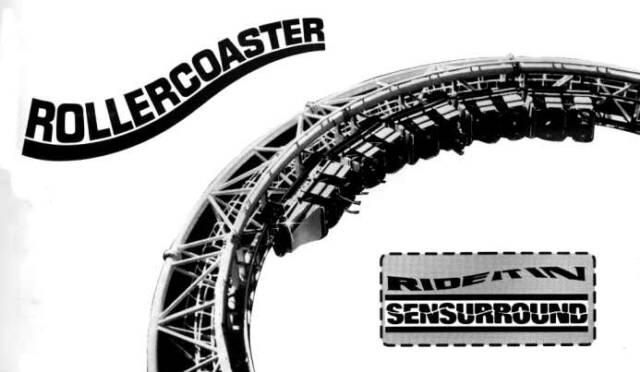
10.) Sensurround (Earthquake - 1974 / Midway - 1976 / Rollercoaster - 1977 / Battlestar Galactica: The Movie - 1978) ]


All right, four films across five years, maybe that doesn't entirely count as "never catching on." However, the story of Sensurround is too good to miss. With an extra set of special speakers installed in the theater, Sensurround utilized ultra low frequency sound waves to produce real vibrations and rumbles which could actually be felt by the patrons. This process was used during the noisier parts of the earthquake scenes since the low frequency also produced sound in addition to the vibrations. During Earthquake's run, Mann's Chinese Theater in Los Angeles developed cracks in the ceiling (however, the theater owners installed netting to catch the plaster rather than end the hit film's run); several people experienced nosebleeds across the country; some theaters and adjacent buildings were structurally damaged; and reportedly one poor soul somewhere suffered cracked ribs! The process was refined twice, adding more sound range for Midway and Rollercoaster and then culminating in Sensurround III for Battlestar Galactica. For the latter, the process used infrasonic effects that could be felt but NOT heard. Thus, scenes could have dialogue and other audio at standard levels while accompanied by the effect of movement. Or, the infrasonic sounds could be combined with higher frequency sounds to create the effect of wind; this was used when the Battlestar Atlantia explodes. And as the Viper spaceships took off down the launch tubes, the infrasonic waves were quickly 'panned' from the back to the front of the theater, creating the sensation of "launching" in the audience. However, the fact that the system had to be specially installed (800 theaters had it in the U.S.), that there was a weekly rental fee to Universal Studios, and that it could only be used for special movies eventually killed Sensurround.


Until next time...you can Poke Me With A Fork, Cause I Am Outta Here!